A road safety audit is not a check that a design meets standards. That is a separate exercise, and the two get confused often enough to cause problems.
An audit asks a different question. Given this design as drawn, what could go wrong for the people using it, and how likely is that to result in injury.
A scheme can comply fully with every standard and still generate audit recommendations. That is the process working rather than failing.
What the process is
Road safety audits in the UK follow GG 119 within the Design Manual for Roads and Bridges. Local authorities apply it to their own networks, sometimes with local variations, and it forms part of what a highway authority expects before agreeing works.
The audit is carried out by a team independent of the designers. That independence is the point. Someone who has spent months developing a layout is poorly placed to spot what a driver unfamiliar with it will do at night in the rain.
The team examines the design from the perspective of every user, including pedestrians, cyclists, motorcyclists, drivers, and people with reduced mobility or sight.
The four stages
Audits are staged, and each looks at something different.
Stage 1 happens at preliminary design. It is the cheapest point to change anything, because the layout is still conceptual. Issues raised here are usually about the fundamentals: where an access sits, whether visibility can be achieved, whether a junction form suits the movements it has to handle.
Stage 2 happens at detailed design, once the scheme is worked up. The focus shifts to specifics, such as signing, road markings, kerb heights, drainage positions and crossing details.
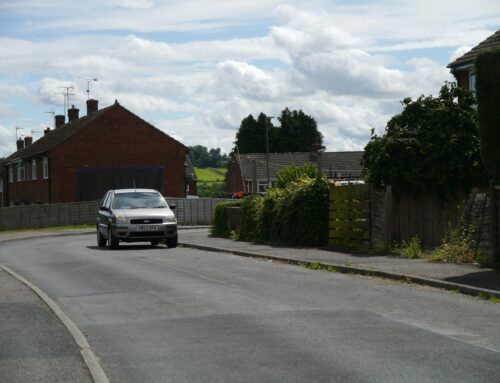
Stage 3 happens after construction and before opening. This is the first time anyone looks at the scheme as built rather than as drawn, and it regularly picks up things drawings cannot show. Sight lines obstructed by a structure, a sign positioned where a parked vehicle hides it, a surface that behaves differently in practice.
Stage 4 is a monitoring stage, carried out after the scheme has been open and carrying traffic, using collision data to see how it is performing in use.
Not every scheme requires all four. Smaller schemes are often combined or scoped down, and the highway authority sets what is needed.
Who commissions it and who pays
For development-led works, the developer generally commissions and funds the audit, even though it examines a design their own consultant produced.
That arrangement is what makes independence matter. The audit team must not have been involved in the design, and for larger schemes there are requirements around the experience of the team and the presence of a certified auditor.
Where works are being delivered under a Section 278 or Section 38 agreement, the audit forms part of what the authority reviews before approving the design.
What happens to the recommendations
This is the part that catches people out.
The audit produces a report listing problems and recommending measures. The designer then produces a response, accepting each recommendation or setting out why it is not being adopted.
Recommendations can be rejected. What cannot happen is silence. A rejection needs a reasoned exception report explaining the decision, and that report is signed off by the client organisation rather than the designer alone. The authority then decides whether it accepts that position.
So an audit does not automatically dictate the design. It creates a documented decision trail about safety, which is a different and more useful thing.
Where problems arise
A few patterns come up repeatedly.
Audits commissioned too late. A Stage 1 audit run after the layout has been fixed around plot positions is a Stage 1 audit in name only, because the recommendations arrive when nothing fundamental can move.
Stage 3 findings that require rework. Something built slightly differently to the drawing, or a sign installed where it obstructs visibility, becomes a construction issue rather than a design one, with the cost that implies.
Recommendations left unresolved as an application progresses, which becomes a blocker at the point of technical approval rather than being dealt with when it surfaced.
Vegetation and street furniture. Sight lines that work on a drawing routinely fail on site because of a hedge, a bin store or a lighting column nobody plotted.
Making the process work for the scheme
The schemes that go through smoothly tend to do a few things.
Run Stage 1 early enough that the answers can change the design. Where a site access is likely to be contentious, this pays for itself several times over, and it fits alongside a site access appraisal at the same point.
Deal with visibility properly at design stage, including what will be growing there in five years.
Keep the audit and the design team in contact through the response process, so recommendations are understood rather than simply accepted or rejected on paper.
Check as-built against drawings before Stage 3, so anything that has drifted is picked up before the auditor finds it.
A process worth using rather than surviving
Treated as a hurdle, an audit becomes a source of late change and cost.
Treated as an early input, it does something more useful. It tests a design against how people actually behave rather than how a drawing assumes they will, at a point where responding is straightforward.
TPA’s road safety audit service covers all four stages, and examples across scheme types are set out in the project experience pages.
If you have a scheme approaching design freeze, that is the point at which a conversation is worth having. You can reach the team through the London office, the Bristol office, the Cambridge office, the Norwich office or the Welwyn Garden City office.