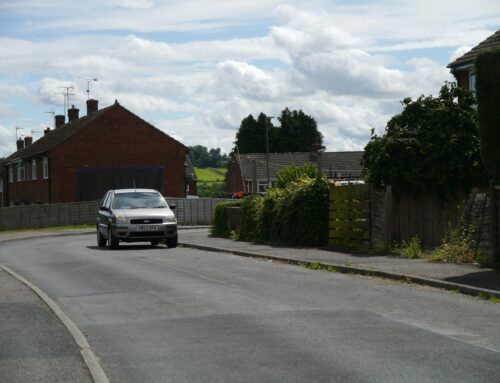
Most conversations about a new development focus on what goes on the site. The number of homes, the layout, the mix of uses. The point where the site meets the public road often gets far less attention, right up until it becomes the reason an application stalls.
Site access is one of the first things a highway authority looks at. If the access does not work, very little else about the scheme matters, because the development cannot be reached safely or in line with policy. Getting it right early tends to set the tone for everything that follows.
Access is the first test a scheme has to pass
A highway authority is not assessing your building. It is assessing how traffic, pedestrians and cyclists will move between your site and the surrounding network.
That means the access has to do several things at once. It needs to be safe for the vehicles using it, suitable for the volume and type of traffic expected, and positioned where drivers can see and be seen. If any of those fall short, the access becomes the weak point in the whole case.
This is why access cannot be treated as a detail to resolve later. It is the foundation the rest of the transport argument sits on.
Visibility splays constrain more than people expect
Visibility splays are the clear sightlines a driver needs when emerging from an access onto the road. They depend on the speed of passing traffic, so faster roads demand longer splays.
The catch is that those sightlines have to be kept clear of obstructions, including hedges, walls, parked cars and street furniture. On a tight site, the land needed to achieve them can eat into the developable area or push the access to a specific point on the frontage.
Where visibility cannot be achieved within the site or the adopted highway, the access may not be acceptable at all. That is a problem worth finding at the start, not after a layout has been drawn around it.
Geometry has to suit the vehicles that will actually use it
An access designed for cars will not necessarily work for refuse vehicles, delivery lorries or emergency services. The width, the kerb radii and the turning space all have to suit the largest vehicle that needs to use the site regularly.
Get this wrong and vehicles end up mounting kerbs, blocking the carriageway, or being unable to enter at all. Refuse and emergency access in particular are checked closely, because a layout that a fire appliance cannot reach is rarely going to be supported.
Testing the geometry against real vehicle movements is the only reliable way to know it works. This is where swept path analysis earns its place, by proving the manoeuvres rather than assuming them.
Access is about more than vehicles
Modern policy expects new development to support walking and cycling, not just driving. An access that ignores pedestrians and cyclists is increasingly likely to attract objections.
That means thinking about footway connections, safe crossing points, and how someone on foot or on a bike moves into and out of the site. Where the access crosses an existing footway or cycle route, the design needs to protect those users rather than treat them as an afterthought.
The shift towards sustainable travel has changed what a good access looks like. The thinking behind that shift is set out in this look at how active travel requirements are changing the way developments get approved.
Why the access often shapes the rest of the layout
Because the access has so many constraints attached to it, it frequently dictates how the rest of the site is arranged.
The position of the access affects internal road layout, the location of parking, and how vehicles circulate once inside. If the access can only go in one place, the layout has to respond to that. Designing the site first and forcing an access in afterwards usually leads to compromises that are obvious to a reviewer.
Starting with a workable access, then building the layout around it, produces a scheme that holds together. It also avoids the costly redesign that follows when an assumed access turns out not to be deliverable.
Building the access is a separate step again
Even once an access is agreed in principle, constructing it on the public highway brings its own process. Works on or affecting the adopted road are usually delivered through a legal agreement with the highway authority, which sets out what is built and to what standard.
That side of things is explained in this breakdown of Section 278 and Section 38 agreements. Knowing it is coming helps you plan for the time and cost involved, rather than treating it as a surprise near the end of the project.
Test the access before you commit to a layout
The pattern across stalled schemes is similar. An access was assumed to work, the design proceeded on that basis, and the problem only surfaced when the authority reviewed it.
Checking the access early, against visibility, geometry and policy, removes most of that risk. It is far cheaper to adjust an access at concept stage than to unpick a finished layout. Examples of how access and layout are developed together can be seen across TPA’s project experience.
Talk it through before it becomes a problem
If you are looking at a site and are not sure whether the access will stand up, it is worth getting a view before the design is fixed. A short appraisal early on can save months later.
You can get in touch with the team via the London office, the Bristol office, or the Cambridge office to talk through your site.